This is a guest post from William Oates, University Archivist, Heritage Centre University of New England.
The team at the University of New England (UNE) and Regional Archives has been trialling dating some of the photographs in their collection using the shadows cast by the sun. The two photos in this post are from a series of 29 photograph albums created by the White sisters of ‘Saumarez’ Homestead near Armidale. Donated by the family to the regional archives at UNE, these images capture aspects of the late Victorian and Edwardian rural lifestyle enjoyed by the White family.
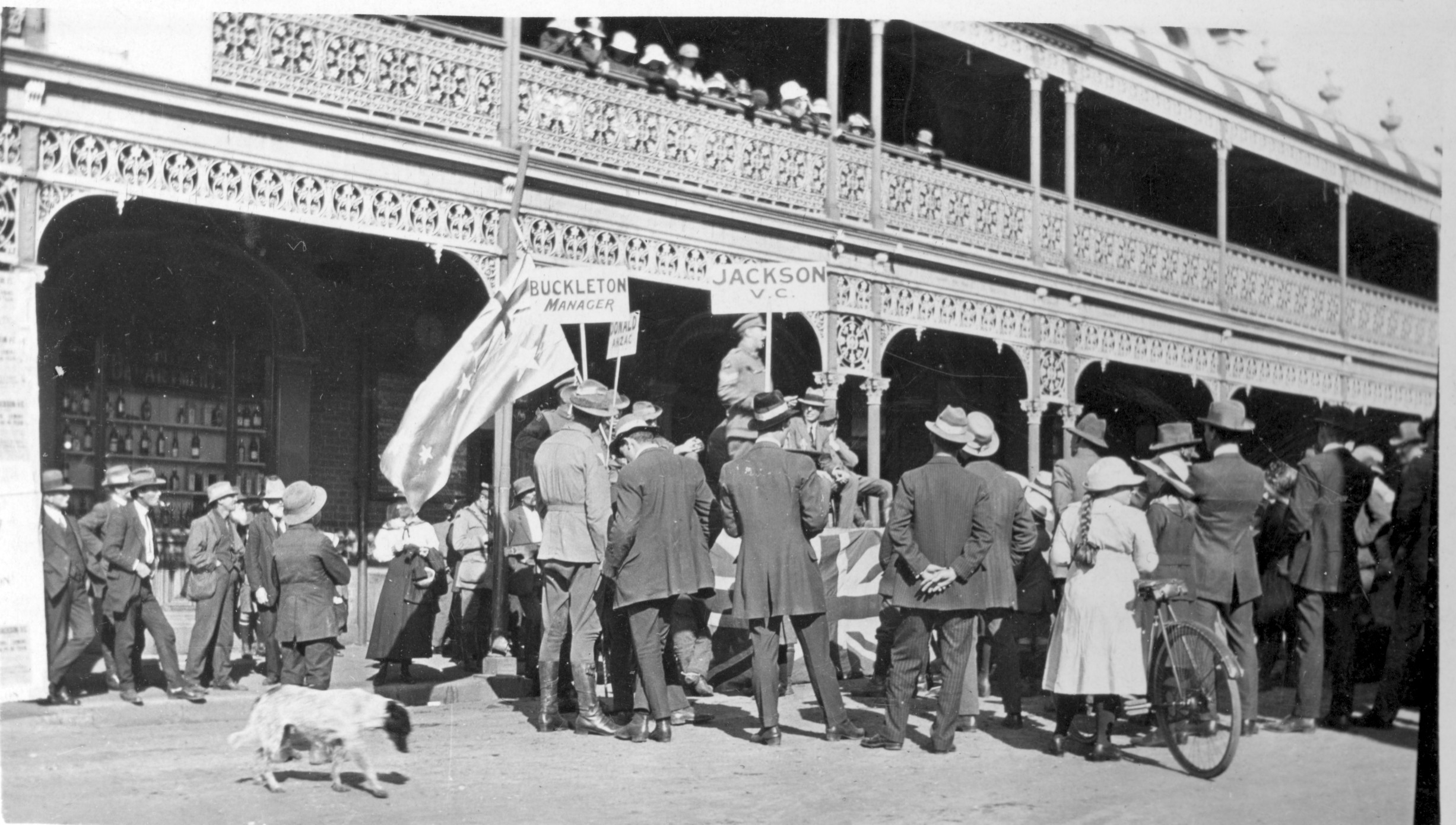
Military Rally - Imperial Hotel, Armidale
The photographs in question portray scenes from a recruitment rally in the streets of Armidale during World War One. One precise method for dating of the event could have been obtained by reviewing newspaper articles during the war years. Instead, dating methodology using the shadows cast by the sun on a given map reference was tested by a volunteer at the UNE & Regional Archives.

Military Rally - Imperial Hotel Armidale
The location of the photo was easily identified from the hotel in the background. A shadow of identifiable length was found in one picture and from this a number of possible dates generated from the available algorithm. Once this date was calculated, we then searched the newspapers to locate the story.
On the 11th August 1917, a recruiting team for the Australian Imperial Forces was invited to a series of functions in Armidale according to the Armidale Chronicle. This team included Victoria Cross winner Billy Jackson who lost his hand in action in France in 1916. The moment captured by one of the White girls clearly shows the recruiting team with Jackson in attendance.
Using shadows to date photographs (part 2)
William Oates
(Photographs courtesy of: University of New England and Regional Archives – (A1473) White Family Photographs – Album 4. Please contact for further information)
Michael Smith (Uni Western Sydney) says:
William,
This sounds really fascinating. I have a couple of questions …
(1) Did you already know the date of the photos you tested? Ie did you test first on known dates to see how accurate the calculations are?
(2) How many dates does the algorithm spit out? (I’m sure it varies but ball park)
(3) Do you need to know where the photo was taken to get an accurate date.
We use a range of factors to identify dates in our photographic collection. This can be very time consuming and not always terribly accurate. And of course there are some where I suspect we will just never know.
Finally, shall we see this written up in more detail in, say, a distinguished journal, at some stage?
Fiona Sullivan says:
Thanks for questions Michael. The answers were so interesting we created a new post for the response:
Using shadows to date photographs (part 2) .
Helen Cairns says:
can you share this algorithm? I have access to quite a few old photo collections, some dates known and some unknown.
Fiona Sullivan says:
Helen, If you want to give this process a try your best bet is probably to get hold of one of the books on the subject. This is the book used by William Oates & Michael Reed when they worked on these photo’s:
“Forensic Genealogy” by C Fitzpatrick ISBN: 9780976716006 (This book contains the CD to generate the math.) . I’d be interested to hear how it works out.
Sue Govali says:
Hi Fiona
Wow! Being an amateur photographer myself, I find this topic and discussion fascinating. Read your second post about this as well and immediately placed an order for the book you recommended!
I was searching online for information on “Snapsleuthing”, however didn’t really come up with too much relevant information pertaining to this :( Your posts and reference links are my only savior! I hope that Mr. Reed gets on with it and publish some journal articles!
Could you inform us if he ever publishes anything? I for one would be most interested to learn more!
Fiona Sullivan says:
Hi Sue,
Thanks for your comment. I’m glad you liked the post! I will definitely let you know if Mr Reed publishes anything on the subject. He is a very busy man with many interests so I’m not sure when that will be.
Mr Reed did however, pop up for a special guest appearance on the blog this week to solve our fornightly, “Can you Date this Photograph?” mystery. http://archivesoutside.records.nsw.gov.au/can-you-date-this-photograph-wagga-wagga-council-chambers/
Tim Driver says:
Wo this is really interesting – Do you need to know the heights of fixed buildings etc to make this calculation oe is it scaled from the picture so that as long as you know the location the photograph was taken and you can see the subject and shadow the computer can make a calculation.
would the focal length of the lens used have a difference in the results data ?
Thanks
Tim
William Oates says:
Very good question in relation to the focal length of the lens used to take a photo.
The measurements used in the process are scaled from the picture. It would help to know any given height to assist with this scaling. The process depends on taking measurements from the photo and correcting for perspective distortion. Given you would rarely know the focal length used, the problem is resolved by determining the vanishing point within the photo and then providing relevant measurement data for the algorithm from Colleen Fitzgeralds book Forensic Genealogy. This works around the absence of focal length information.